
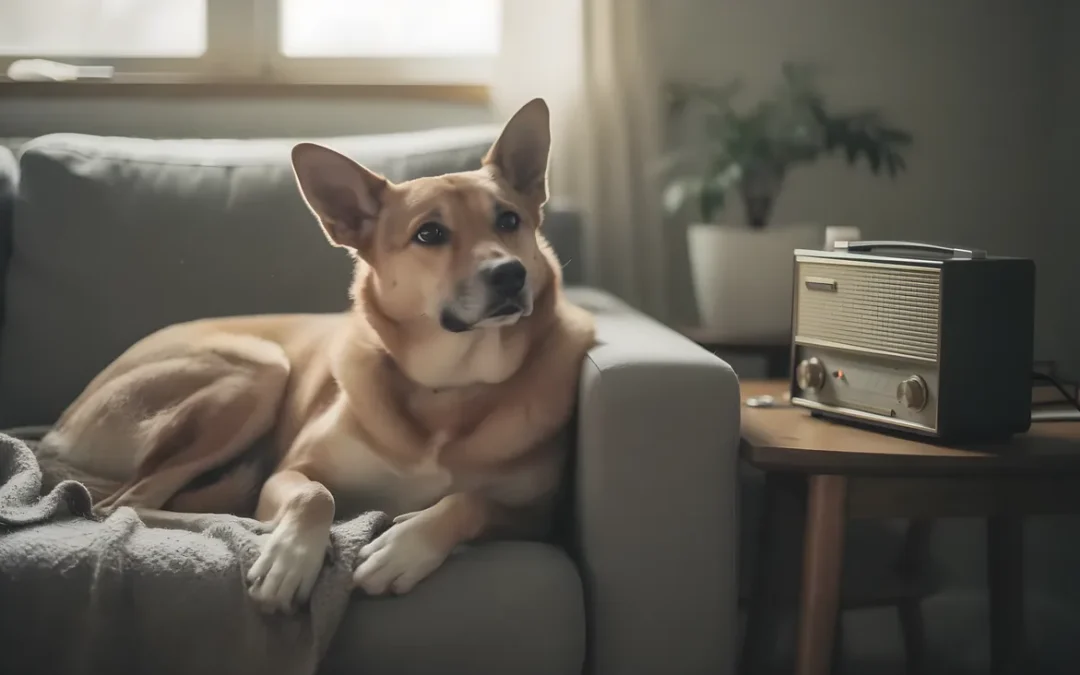
Charlie was pacing when I got there. The radio was blasting, loud enough to hear from the front porch. His pet parent had read somewhere that leaving it on would help with his anxiety while she was at work.
Charlie was not helped.
I turned the radio off. He circled the living room twice and settled onto the couch. Sometimes what we think is soothing is actually the opposite.
That experience is pretty common in this work. After ten years of in-home visits across McKinney and Melissa, I’ve seen dogs sleep through construction next door and I’ve seen dogs lose their minds over a commercial with a doorbell. Every dog is different. But there are real patterns worth knowing before you leave something playing all day.
Here’s what I know, what the research says, and what actually tends to help.
Background audio can help some dogs with mild boredom or noise sensitivity, but the research on which type of audio matters, and for which dogs, is more specific than most pet parents expect. Dr. Deborah Wells at Queen’s University Belfast found that for dogs already dealing with acute separation stress, classical music produced little to no measurable benefit, and silence was sometimes better. Earlier work from Colorado State University, published in the Journal of Veterinary Behavior, found classical music did calm shelter dogs: less barking, more sleep. Heavy metal produced the opposite effect. A 2017 study by the Scottish SPCA and the University of Glasgow tested five genres across 38 shelter dogs. Reggae and soft rock came out on top for lowering stress markers as measured by heart rate variability and cortisol levels. Not classical. Reggae. The bottom line: background audio helps most with noise masking and mild boredom. It does not resolve clinical separation anxiety. Those are different problems with different solutions.
Does Leaving a Radio on Actually Help Dogs?
Leaving a radio on for your dog reduces stress-related behaviors when the dog’s problem is noise reactivity or mild boredom, not clinical separation anxiety. That distinction matters more than anything else on this list.
Dogs Tune Out the Same Audio Within 48 Hours
Bowman et al. (Applied Animal Behaviour Science, 2017) found dogs stopped responding to repeated audio within 24 to 48 hours. Looping the same playlist every day is unlikely to help past the first couple of days. Rotate genres a few times a week to keep the benefit going.
Keep It Between 45 and 55 Decibels
Dog hearing reaches frequencies up to 65,000 Hz, roughly three times the human range. Researchers recommend keeping ambient audio between 45 and 55 decibels for dogs. If you can hear it clearly from the next room, it is probably too loud.
Dogs in quieter neighborhoods, calm and settled, often don’t seem to need background audio at all. Dogs in busier areas, where there’s construction on a nearby street, lawn crews working the block, or a neighbor’s dog barking from a yard, tend to settle better with something playing. The audio masks the triggers. That’s where radio earns its keep.
Where it doesn’t help: true separation anxiety. A dog who is genuinely distressed about being alone isn’t soothed by Mozart. The Queen’s University Belfast research confirmed what a lot of us in the field have suspected: for a dog in clinical distress, the radio becomes one more thing happening while they’re still in crisis. For a dog who just gets a little bored or a little reactive to outside sounds, it can make a real difference.
One more thing the research found: dogs habituate to the same audio fast. A 2017 study by Bowman et al. in Applied Animal Behaviour Science found that dogs stopped responding to repeated audio within 24 to 48 hours. Looping the same playlist on repeat every day is unlikely to help past the first couple of days. The audio needs to change.
The Pros of Leaving a Radio on for Your Dog
Reduced Loneliness
Purpose-Built Audio Outperforms Generic Radio
Clinical trials for iCalmPet, audio designed around dog hearing ranges and tempo sensitivity, showed over 70% of kenneled dogs calmed: roughly twice the effect of conventional classical music. It is available on Spotify, Apple Music, and Amazon Music.
Dogs are social animals and can experience separation distress when left alone. Having the radio on might provide some auditory stimulation, making them feel less isolated. They can’t be fooled indefinitely; they know the difference between a recording and a real person. But for many dogs, ambient sound signals that the world is still going, even if their person isn’t home. That ambient sense of activity can take the edge off a long day.
Masking External Noises
This is the most research-supported benefit on the list, and it’s also the one I see play out most often in client homes.
If your dog is sensitive to outside noises, whether that’s thunderstorms, fireworks, construction sounds, lawn crews, or delivery trucks, having background audio at a reasonable volume can help mask those triggers. In McKinney neighborhoods where there’s active street traffic or seasonal landscaping crews, this matters more than you might think. I’ve visited homes where the dog is completely relaxed, but the moment a truck rolls up to the neighbor’s house, the whole energy shifts. A little ambient audio running in the background can muffle that trigger enough to prevent the spiral.
Volume matters here. Dog hearing detects frequencies up to 45,000 to 65,000 Hz, compared to a human’s upper limit of roughly 20,000 Hz. Researchers suggest keeping ambient audio between 45 and 55 decibels for dogs, well below what feels loud to a person. If you can hear it clearly from the next room, it’s probably too loud.
Familiar Sounds
In my experience, dogs who hear background audio regularly when their pet parent is home tend to treat it as neutral, just part of what the house sounds like. When the same sound is there after you leave, it reads as continuity instead of absence. I’ve noticed this especially with dogs who’ve been clients since they were puppies. Bailey, a golden I’ve been visiting in Stonebridge Ranch since 2021, settled almost immediately when her pet parent started leaving low music on. Same radio station she played during dinner every night.
There’s a flip side to this, and I’ll get into it in the cons. Timing matters. If background audio is always on when you’re home and on when you’re gone, it reads as neutral. If it only goes on when you leave, it becomes a departure signal. That’s the opposite of what you want.
Calming Effect
Classical music has the strongest shelter-study evidence for reducing barking and increasing rest. The Scottish SPCA and University of Glasgow study found reggae and soft rock performed best for measurable stress reduction across 38 dogs. Psychoacoustically designed audio, specifically the iCalmPet program (formerly marketed as Through a Dog’s Ear), showed clinical trial results of over 70% of kenneled dogs calmed, roughly twice the effect of conventional classical music. iCalmPet is available on Spotify, Apple Music, and Amazon Music. Worth trying before you settle on just leaving the FM dial wherever it landed.
The Cons of Leaving a Radio on for Your Dog
Unfamiliar or Harsh Sounds
The Departure Cue Trap
If the radio only goes on when you leave, your dog learns to associate it with your absence. The fix is simple: play background audio throughout the day when you are home, too. The goal is for the dog to stop noticing it entirely.
If you’re leaving a radio station on that plays loud or unfamiliar music, it could stress your dog out more. Dogs have sensitive hearing, and sudden or harsh sounds can startle them.
Specific things to avoid: heavy metal, loud talk radio with hosts interrupting each other, news programs that run audio clips with sirens, and any program that plays doorbells in commercials. That last one is more common than you’d think. A dog reacting every time a TV spot rings a doorbell is not calmer. That dog is more worked up than it would be in silence.
Overstimulation
Dogs can tolerate a lot of background sound, but there’s a real ceiling. Above about 65 decibels, what registers as comfortable background noise to you starts landing differently for a dog whose hearing tops out at frequencies five times higher than yours. Constant exposure without any quiet periods can prevent rest or cause sensory overload.
If you come home and your dog seems restless, moving around more than usual, or wired rather than relaxed, the audio might be the problem, not the solution. If your dog leaves the room where the radio is playing, that’s a message.
Dependence and the Departure Cue Trap
If your dog becomes overly reliant on the radio for comfort, it might make separation distress worse when the radio is turned off, or when you’re in a situation where it isn’t possible to use it.
Here’s the specific version of this problem: a dog who only hears background audio when you leave learns to associate it with your absence. The radio turns on, you walk out the door, and now the radio itself is a stress signal. The fix is simple. Play background audio throughout the day when you’re home too. Make it neutral background rather than a leaving sound. The goal is for the dog to stop noticing it entirely.
The Same Playlist Stops Working
The habituation effect is real: Bowman et al. documented complete response extinction within one to two days of continuous exposure. Novelty drives the calming benefit. If you’re looping the same playlist every single day, you’re probably not getting the benefit you think you are by week two. Rotate genres. Switch between classical, soft rock, and specifically designed calming content like iCalmPet. Keep it varied.
Not a Treatment for True Separation Anxiety
For dogs who are just bored or mildly triggered by outside sounds, ambient audio can genuinely help. Clinical separation anxiety is a different condition entirely.
A dog who is destructive when alone, who hurts itself, who cannot settle within the first 30 minutes of you leaving: that is a behavioral condition. The American Animal Hospital Association and the American Veterinary Society of Animal Behavior both state this plainly. Music is not a treatment for clinical cases. A veterinarian or certified applied animal behaviorist is the right call, sometimes alongside behavior modification medication. Knowing that line, and calling it honestly, matters.
What Kind of Music or Audio Is Best for Dogs?
The research points to a few clear answers.
Among genres tested in controlled environments, classical compositions consistently reduced barking frequency and increased time spent resting. The five-genre trial at Scottish kennels placed reggae and soft rock ahead of classical for lowering cortisol and stabilizing heart rate variability. Psychoacoustically designed programs from iCalmPet outperformed all conventional genres, calming over 70% of kenneled dogs in clinical trials.
For specific options available today:
iHeart Pet Radio launched in March 2024 and is free via the iHeart app, Alexa, and most smart TVs. Content selections are built around the research of Dr. Deborah Wells, the Scottish SPCA, and Colorado State University animal welfare studies. It’s a practical starting point.
iCalmPet playlists on Spotify or Apple Music: search directly for them. These are designed specifically for dog hearing ranges and tempo sensitivity, developed in partnership with veterinary behaviorists.
White noise: if the goal is noise masking rather than auditory enrichment, broadband white noise showed the most consistent rest behavior in a 2021 Animals journal study. Simple and effective.
What to avoid: heavy metal, hard rock, anything with sudden loud volume shifts, talk radio with high-energy segments, stations with loud commercial breaks, and TV programs that include doorbells, sirens, or barking dogs in the audio. The AKC and ASPCA both recommend keeping audio at conversational volume (below 60 decibels) for dogs left alone.
Should You Leave the Radio on for Your Dog at Night?
The same principles apply at night, but the triggers shift.
During the day it’s delivery trucks, lawn crews, and foot traffic. At night in North Texas it’s different: wildlife moving through yards, neighbors coming home late, summer fireworks around holidays. Dogs who sleep restlessly or bark at nighttime sounds sometimes settle better with low-volume background audio running.
For dogs who sleep soundly in silence, leave them to it.
One adjustment for nighttime: go quieter than you would during the day. Your dog’s ears don’t shut off when they sleep. If anything, keep it to barely audible. Some dogs just want to know the house is alive. A little sound is enough.
How to Tell If the Radio Is Helping Your Dog
The only honest way to know what’s happening when you’re gone is a pet camera. What you come home to is not what was happening an hour after you left. I’ve seen both in client homes: dogs who looked completely fine when the pet parent walked in but were frantic for the first hour and a half. And dogs who were calm the entire time. You can’t know without watching.
Quick Reference: Is the Audio Helping?
Signs it is helping
- Settles within 15 to 20 minutes of you leaving
- Less barking or pacing than without audio
- Resting, not repositioning constantly
- Goes to a usual spot instead of camping by the door
Signs it is not helping
- Leaves the room where the audio is playing
- Panting without physical exertion
- Repeated lip-licking or yawning
- Same rate of barking or pacing as without audio
Signs the audio is helping: – Dog settles within 15 to 20 minutes of you leaving – Less barking or pacing than without audio – Dog is resting, not repositioning constantly – Dog goes to a usual spot instead of camping by the door
Signs it’s not helping: – Actively avoids the space with the speaker – Panting without physical exertion – Repeated lip-licking or yawning (stress signals in dogs, not boredom) – Same rate of barking or pacing as without audio
Test with and without. Give it several days of data before drawing conclusions from a single visit.
Tips for Getting the Most Out of Background Sound
Experiment. Start with low volume and watch your dog’s reaction. If the dog seems restless or uncomfortable, switch genres or turn it off. If the dog settles, keep going. Monitor behavior over several days, not one trial. One good day doesn’t prove it’s working. One bad day doesn’t prove it isn’t.
Consider dedicated options. iCalmPet, iHeart Pet Radio, DogTV (a streaming channel designed for dogs’ visual and audio processing range), and white noise machines are all more targeted than leaving a generic AM/FM station on whatever it was tuned to last. Generic radio is a starting point. These are a step up.
Consult a professional if the problem is bigger. There’s a real line between “a little restless without company” and clinical distress, and ambient audio won’t cross it. If your dog is destructive when alone, hurting itself, or in visible distress within minutes of you leaving, that is not a background-sound problem. A professional dog trainer or veterinary behaviorist can give you a real plan.
Play it while you’re home. A dog who only hears audio when the house empties learns to read it as an absence cue. Use it throughout the day so your dog hears it as neutral background. That’s the whole point.
Rotate what you play. Dogs habituate to repeated audio within 24 to 48 hours (Bowman et al., 2017). Switching genres or playlists keeps it fresh and extends the benefit. Set a reminder and change it up a few times a week.
Frequently Asked Questions
Is it better to leave a dog in silence or with the radio on?
It depends on the dog and the problem you’re trying to solve. For dogs who react to external sounds like delivery trucks, neighbors, or other dogs barking, low-volume background audio often helps by masking those triggers. For dogs with clinical separation anxiety, the Queen’s University Belfast studies showed that no genre of music outperformed quiet in reducing acute stress behaviors. Test both with a pet camera and let your specific dog give you the answer.
Do dogs prefer silence or TV?
Most behavioral research was conducted with radio and music, not television. TV adds visual stimulation, but dogs process video differently than humans, seeing more fragmented images rather than continuous scenes. For sound purposes, music or radio is better understood and more consistently researched. Some dogs are calmed by the ambient sound of a TV; others are activated by movement on screen. Worth testing, but keep the volume below 60 decibels either way.
What calms a dog down immediately?
The fastest path to a calmer dog at home is consistent exercise, mental enrichment, and a solid daily routine. Background audio can help with mild boredom or noise reactivity, but it’s a supplement, not a solution. For a dog in real distress, the most effective thing is a person: someone to check in, take the dog for a walk, and break up the alone time. That’s exactly what professional dog walking provides.
What is the 7 7 7 rule for dogs?
The 7-7-7 rule is a puppy socialization benchmark: expose them to 7 different people, 7 different places, and 7 different challenges before 7 weeks (some versions extend to 7 months). It’s about building confidence early and reducing fear responses in new environments. Dogs who are well socialized early tend to be less noise-reactive later, which is exactly the kind of sensitivity that makes background audio feel necessary in the first place.
The most reliable way to give a dog calm, comfortable time at home alone is still an actual person walking through the door. Until then, a little music in the right genre at the right volume can help.
Looking for dog sitting or dog walking in McKinney, Melissa, or Celina? Call 214-244-1629 or contact Top Dog Pet Sitters.
Susan Gary owns Top Dog Pet Sitters in McKinney and Melissa, TX, with her husband, Erick. She has been a professional pet care provider since 2015. Susan is a member of Pet Sitters International, is a founding member of the Texas Pet Sitters Association, and is certified in pet CPR and First Aid.
Looking for dog sitting or dog walking in McKinney, Melissa, or Celina? Call 214-244-1629 or visit the contact page.

Susan Gary owns Top Dog Pet Sitters in McKinney, Melissa, and Celina, TX, with her husband, Erick. She has been a professional pet care provider since 2015. Susan is a member of Pet Sitters International, is a founding member of the Texas Pet Sitters Association, and certified in pet CPR/First Aid. Susan is a long-time McKinney resident and a retired minister. Learn more about her here.