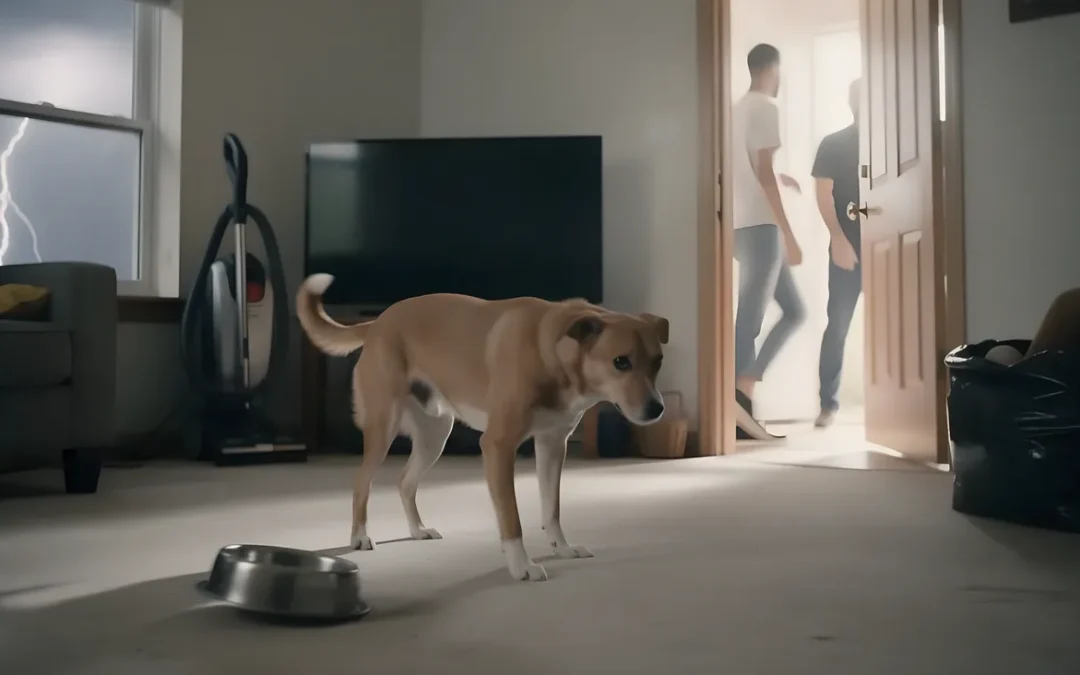
We were on our morning route in McKinney when it happened. Lola, a pup that I walk daily, was trotting along perfectly. Then a yellow school bus rounded the corner, brakes hissing, engine loud. She hit the end of the leash so hard she nearly pulled me off my feet. I have watched Lola be stoic about thunderstorms. Completely fine with the neighbor’s leaf blower. But school buses? NOPE. Full meltdown, every single time.
Lola’s not alone. After 11 years of walking dogs in McKinney, Melissa, and now Celina, I have seen almost every flavor of dog fear there is.
The most common things that scare dogs:
- Loud noises (thunder, fireworks, gunshots, construction, school bus brakes)
- Being left alone (separation anxiety)
- Strangers and unfamiliar visitors
- Other dogs and animals
- Vet visits and the smells that come first
- Car rides
- Household objects (vacuums, smoke alarms, hair dryers)
- Unfamiliar places and routine changes
- Handling and touch (nail trims, ear cleaning, restraint)
- Children
Read on for what each fear actually looks like, why it happens, and what you can do about it.
How to Tell If Your Dog Is Scared
Dog fear shows up in body language long before a dog barks or snaps. Most pet parents miss the early signals because they are watching for the loud ones.
Fear Signal Quick Reference
Whale eye
Whites visible while head turns away. Dog is tracking something they do not trust.
Tucked tail
Between the legs means high fear. Lower than normal still signals stress.
Lip lick or tongue flick
Not hunger. A calming signal that says “I am not a threat.”
Refusing food
If your dog turns down their favorite treat, stress has exceeded their threshold.
Ears flat or pinned
Combined with a lowered body, this is a fear posture, not submission.
Stress panting
Faster and shallower than cool-down panting. Watch for it around a specific trigger.
One rule above all: never punish the growl. It is the warning system. Take it away and the bite comes without a warning.
Whale eye. The whites of the eyes are visible because your dog turns their head away from something while keeping their body still. They are watching the scary thing out of the corner of one eye. If you see it, pay attention.
Tucked tail. Between the legs means high fear. A tail that is lower than normal, without being fully tucked, is still a stress signal.
Lip licking and tongue flick. A quick lick in a non-eating context. The dog is not hungry. This is a calming signal, their way of saying “I’m not a threat.” I see it on walks all the time when we pass something a pup does not trust.
Stress panting. Faster and shallower than regular cool-down panting. In Texas summers this one is easy to miss, but if panting speeds up around a specific trigger, that is the tell.
Refusing food. A scared dog often will not take treats. If your pup turns down their absolute favorite snack, the situation has exceeded their stress threshold. This is one of the most reliable signals I watch for during Meet and Greets.
Ears flat or pinned back. Combined with a lowered body, this is a fear posture.
One more thing: a scared dog who feels trapped may escalate to growling or snapping. Do not punish the growl. The growl is the warning system. Punish it away and the warning disappears, but the fear does not. That is how bite incidents happen.
1. Loud Noises: Thunder, Fireworks, Gunshots, and Construction
Loud noises rank as the single most common fear trigger across all breeds and ages. Research on 13,700 dogs found approximately 32% show noise sensitivity, and close to 49% show a significant fear response to fireworks. Lola’s school bus reaction shows just how specific these triggers can get.
Before July 4th: What to Set Up Now
The ASPCA reports a 30 to 60 percent spike in lost pets from July 4 through July 6. Fewer than 13 percent are reunited. These steps take 10 minutes to set up and make a real difference.
Create a safe room
Interior room, minimal windows, dog’s bed and favorite toys inside. Let them choose to go in before the noise starts, not during.
Add white noise
A fan or white noise machine muffle the triggering frequencies. A TV on loud does not work the same way.
Check ID tags and microchip
Fear does not recognize fences. Make sure contact info is current before the holiday, not after.
Call your vet now, not July 3rd
Anti-anxiety medication for severe phobia needs a prescription and a trial run before the real event. Vet offices book up fast before the holiday.
Here in North Texas, McKinney and Melissa sit in a layered noise environment that puts dogs at above-average risk year-round.
Thunderstorm season (April through June) drops North Texas into one of the most severe storm corridors in the country. Dogs detect the atmospheric pressure drop before a storm arrives. By the time thunder cracks, some dogs have already been anxious for 20 minutes.
Hot air balloon season is a McKinney-specific surprise. The balloon floats silently overhead. Then the propane burner fires with a sudden, loud blast. No warning buildup. That pattern of unpredicted explosive sound drives some of the strongest fear responses I see.
McKinney Red, White and Boom on the Fourth of July is a different level. The ASPCA reports that July 4th is the single biggest lost-pet day in the US, with a 30 to 60 percent spike in lost pets in the July 4 through 6 window. Fewer than 13 percent are reunited. Fear does not recognize fences.
Construction noise runs year-round in McKinney, one of the fastest-growing large cities in the US. Pile drivers, backup beepers, and heavy equipment in residential neighborhoods create persistent, unpredictable sound. That combination is the worst possible pattern for a noise-sensitive dog.
What to do: Set up a safe room before storm season starts. Dark, enclosed, the dog’s choice to enter. White noise helps muffle the triggering frequencies. ThunderShirts work well for mild to moderate cases. For severe phobia, talk to your vet before storm season, not during it.
2. Being Left Alone (Separation Anxiety)
Separation anxiety produces panic-like reactions when a dog is separated from their primary person. It is not misbehavior. It is a clinical anxiety response, affecting an estimated 14 to 29 percent of the general dog population.
Fear, Anxiety, and Phobia: They Are Not the Same Thing
Fear
A normal response to something present and threatening. The trigger is here right now. Fear goes away when the trigger does.
Anxiety
Anticipatory distress about something expected. The dog who paces when you pick up your keys is not afraid of the keys. They are anxious about what the keys predict.
Phobia
An extreme, persistent reaction that is out of proportion to the actual threat. A phobic dog may not recover between exposures and often needs veterinary support.
Separation anxiety is classified as an anxiety disorder, not a fear. That distinction matters for treatment. Desensitization alone is often not enough.
Fear needs a trigger present. Anxiety is anticipatory. The dog who paces when you pick up your keys is not afraid of your keys. They are anxious about what the keys predict.
Since Covid, we have cared for numerous pups with separation anxiety, and I sought out continuing education through Pet Sitters International specifically on this topic. The pattern was consistent: over 23 million American households added dogs during the pandemic. Those dogs spent months with their people home nearly around the clock. When offices reopened, those dogs faced real separation for the first time.
What separation anxiety looks like: the destruction concentrates near exits. Doors. Windows. The dog is not bored. They are trying to get out to find their person.
What to do: Start with very short absences. One minute. Then five. Then fifteen. Pair departure cues (keys, shoes, coat) with something positive before those cues mean anything stressful. If SA is severe, your vet can help. Medication alongside behavior modification produces better outcomes than either approach alone.
3. Strangers and New Visitors
Some dogs are cautious around new people by nature. Some have histories that make strangers feel threatening. Some are perfectly social with women but tense around men, often because of experiences before they were rescued. This is not a character flaw.
The situation I see most in my work: a sitter arrives for the first time. The pet parent has left. The dog is now alone with someone they have never met, in their own home. Some take that in stride. Others freeze, hide, or bark.
This is why our Meet and Greet exists. Before any solo pet care starts, I or the sitter assigned to the household meets the dog in their own home while the pet parent is still there. The dog gets to smell us, watch us, and decide we are okay on their own terms. No care starts until the dog is comfortable.
What to do: Let the dog approach strangers on their own schedule. Instruct visitors to crouch low, avoid direct eye contact, and offer a treat close to the ground. Never let someone rush up and reach over a dog’s head. That gesture, however friendly the human intends it, reads as threatening to many dogs.
4. Other Dogs and Animals
A single bad encounter as a puppy can encode a lasting fear response. Dogs who were not properly socialized during the critical socialization window (weeks 3 through 14 of life), or who had one genuinely frightening encounter, often carry that wariness for life.
One thing that surprises people: a dog lunging and barking at another dog may not be acting from dominance. Many are acting from fear. The aggression is preemptive. The dog is trying to make the scary thing go away before anything bad can happen.
What to do: Controlled introductions, on neutral ground, both dogs leashed, no forced greetings. Let both dogs sniff from a distance before any closer contact. Never push a dog into a greeting they are not ready for.
5. Vet Visits (and the Smells That Come First)
Dogs have approximately 300 million scent receptors compared to our 6 million, and the olfactory bulb connects directly to the limbic system, where fear memories live. Your dog may begin showing anxiety in the vet’s parking lot, not because they see the building, but because they smell the antiseptic and the stress hormones of other animals. The smell of the vet arrives before the building does.
What to do: If your vet is not Fear Free certified, ask about their low-stress handling protocols. Fear Free trains practices in pre-visit calming medications, non-slip mats, and gentle handling. An increasing number of clinics in the Collin County area have pursued this certification. If your dog has a strong negative association with the vet, try visiting just the waiting room a few times with no procedure involved. Walk in, get treats from the front desk, leave. Changing the association takes repetition.
6. Car Rides
Two separate problems can look identical. Motion sickness is physical: the dog is nauseous. Negative association is behavioral: the dog panics before the car even moves because the car always goes somewhere stressful.
A dog who is sick needs a medical solution. A dog who panics before the engine starts needs desensitization and positive pairing.
What to do: Make some trips that go nowhere stressful. Drive around the block. Go somewhere the dog actually likes. A covered crate in the back can help: for some dogs, the enclosed space feels like a den. And harness and seat belt, every time.
7. Household Objects (Vacuums, Smoke Alarms, Hair Dryers)
Around a third of dogs show fear of vacuum cleaners. The vacuum moves unpredictably, makes aggressive noise, and seems to chase things for no apparent reason. From a dog’s perspective, it is a large aggressive creature that cannot be trusted.
Smoke alarm batteries die at 2am. The resulting chirp is a high-pitched, sudden sound with no warning. Umbrellas open suddenly and appear to explode in size. Motorcycles accelerate without warning. Bicycles approach silently and then sweep past.
The common thread is unpredictable movement combined with sudden noise.
What to do: Start with the vacuum unplugged and on the floor. Let the dog sniff it. Reward them. Do that a few times before you ever turn it on. Gradual exposure below the fear threshold, paired with something the dog values, turns a threat into a predictor of good things.
8. Unfamiliar Places and Routine Changes
Dogs use routine as a safety signal. The walk at 7am, the feeding at the same time, the furniture in the same arrangement. A rearranged living room is not decoration to your dog. It is a change in their mapped world.
I had a client dog named Biscuit who would stand in the living room doorway for a full minute every time his pet parents moved the couch. Not barking. Not fleeing. Just processing.
When we send a sitter for the first time, the dog is managing two changes at once: the unfamiliar person and the unfamiliar routine. This is another reason our Meet and Greet is not optional. By the time a sitter comes alone, the dog has already met us. One of the two variables is already known.
What to do: When traveling or boarding, bring the dog’s own bed or blanket. A piece of your unwashed clothing carries your scent and can reduce anxiety in an unfamiliar environment. For already-anxious dogs, a night light or TV on low can genuinely help.
9. Handling and Touch
Paws are sensitive, and having them handled can feel vulnerable in a way that the back or the side does not. This is why nail trims are so stressful. The position itself (paw held, body restrained) is threatening before the clippers appear.
Common triggers: being restrained, paws touched, ears cleaned, nails trimmed, body lifted without warning.
What to do: Touch the paw. Give a treat. Stop. That is the whole exercise at first. Repeat over days. Never force. Puppies who are gently handled throughout their bodies from an early age have a significantly easier time at the vet and groomer throughout their lives. That early investment pays off for years.
10. Children
Children move fast, at dog height, and they approach with gestures that many dogs read as threatening. Direct eye contact. Reaching over the head. Moving without warning. Squealing. None of this is the child’s fault. It is just how children move through the world, and it happens to check a lot of boxes that put a dog on edge.
We work with plenty of McKinney families who have both kids and dogs in the house. The families that do it best are the ones who taught the kids early.
What to do: No hugging dogs they do not know well. No approaching from above. Pet under the chin, not over the head. Let the dog sniff first. Punishing a scared dog makes the fear worse. The child also needs to learn what friendly looks like to a dog, not just to a person.
When Fear Needs Professional Help
Most dog fears are manageable with patience and consistency. Some are not, and knowing the difference matters.
Call Your Vet: Signs That Cannot Wait
Patience and consistency handle most dog fears. These signs mean the situation has gone beyond what patience alone can fix.
Sudden fear in a confident adult dog
New anxiety can signal pain, thyroid disease, vision or hearing loss, or neurological changes. Rule out medical causes first.
Fear spanning many unrelated triggers
Scared of thunder, strangers, the vet, and car rides simultaneously? That is generalized anxiety, not a collection of specific fears.
Self-injury during fear events
Breaking through windows, destroying doors, injuring paws trying to escape. This needs professional management now, not eventually.
Biting or snapping out of fear
A professional behavior consultation, not a training video. Ask your vet for a referral to a board-certified veterinary behaviorist (DACVB).
Sudden fear in an adult dog that was previously confident is a vet referral signal. New anxiety can indicate pain, thyroid disease, vision or hearing loss, or neurological changes. Rule out medical causes before assuming it is behavioral.
Fear that spans many triggers at once is different from a dog with one or two specific fears. A dog scared of thunder, strangers, the vet, and car rides simultaneously likely has generalized anxiety. That warrants a conversation with your vet.
Fear that is escalating despite your efforts will not work itself out. Early professional intervention produces better outcomes than waiting.
Self-injury during fear events (breaking through windows, destroying doors, injuring paws trying to escape) needs professional management now.
Biting or snapping out of fear needs a professional, not a training video.
Start with your primary care vet to rule out medical causes and discuss medication options. For complex cases, ask for a referral to a board-certified veterinary behaviorist (DACVB). These are veterinarians with a specialty certification in animal behavior, not the same as a dog trainer.
I say this with genuine care. There is no shame in asking for help when your dog needs more than you can give them on your own.
How We Work With Fearful Dogs
I started Top Dog Pet Sitters in McKinney in 2015, and caring for dogs with anxiety or specific fears has been part of this work from the beginning. We are a PSI member, bonded, insured, and pet CPR/First Aid certified. But the most important thing we do for fearful dogs happens before we ever show up alone.
Every client relationship starts with a Meet and Greet, our required first step before any pet care begins. You, your dog, and your sitter in your dog’s own home, while you are still there. Your dog gets to smell us and watch us before anyone is relying on us. If a dog is showing whale eye or refusing treats during a Meet and Greet, that tells us something. We take it seriously.
Our sitters watch the same body language signals I described at the top of this post. A tucked tail on a normally confident dog means something. A lip lick when we reach for the leash means something. We notice.
If you have a pup in McKinney, Melissa, or Celina who needs extra patience and a sitter who knows what to watch for, our Meet and Greet is the place to start. You can also learn more about our dog walking and pet sitting services.
Every dog deserves someone who pays attention.
Frequently Asked Questions
Q: What scares dogs the most?
A: Noise tops the list by a wide margin. Nearly half of all dogs react to fireworks, and about a third show sensitivity to thunder, gunshots, and construction. After noise, the next most reported categories are separation from their person, strangers entering the home, and unfamiliar environments.
Q: What would make a dog scared of everything?
A: A dog who reacts with fear to many different triggers is likely dealing with generalized anxiety rather than a collection of specific fears. That is a clinical condition distinct from a specific phobia, and it warrants a vet visit to rule out underlying medical causes and discuss whether medication could make behavioral work more effective.
Q: What are dogs afraid of at night?
A: Darkness removes the visual cues dogs rely on during the day, which can amplify existing anxiety. Common nighttime fears include sounds that are harder to locate in the dark (distant thunder, wildlife in the yard), unfamiliar surroundings when traveling or boarding, and separation from their person after lights go out. A night light or white noise machine helps many dogs settle.
Q: Why is my dog suddenly scared of everything?
A: A confident dog that becomes fearful overnight needs a vet appointment, not a training plan. Undiagnosed pain, thyroid imbalance, or declining vision and hearing often look like behavioral problems until a vet checks. Start with a medical workup before trying behavioral fixes.
Looking for a pet sitter in McKinney, Melissa, or Celina who knows how to read a nervous dog? Call (214) 244-1629 or visit our contact page to schedule a Meet and Greet.

Susan Gary owns Top Dog Pet Sitters in McKinney, Melissa, and Celina, TX, with her husband, Erick. She has been a professional pet care provider since 2015. Susan is a member of Pet Sitters International, is a founding member of the Texas Pet Sitters Association, and certified in pet CPR/First Aid. Susan is a long-time McKinney resident and a retired minister. Learn more about her here.