My cat Peanut rode the whole way from our old house to McKinney under the gas pedal of the moving truck. Not on my lap. Not even in the front seat where I could reach her. Under the gas pedal, for the entire drive.
That’s Peanut. Fifteen years later, she still won’t stay on my lap more than a few seconds at a time. I’ve made my peace with it.
If you can’t get your cat to sit on your lap, it’s not always something you did wrong. Genetics and her early weeks decided most of that.
What actually determines this:
- Genetics, including the temperament passed down from her father
- Whether she was handled gently between about two and seven weeks old, before you ever met her
- What you can control from here: patient, cat-led trust-building
- What you can’t control: rewriting her first two months of life
My team has been voted Best Pet Sitter in McKinney and Melissa. We spend more hours in other people’s houses with other people’s cats than almost anyone in town. Here’s what actually works.
8 Ways to Build Trust With Your Cat
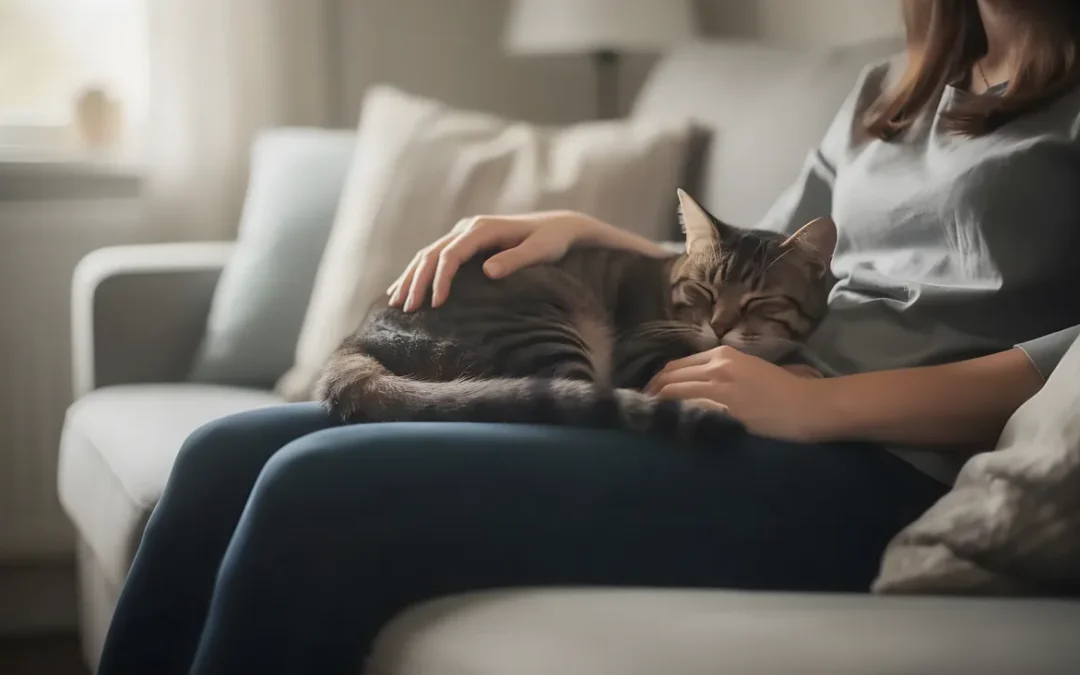
1. Make your lap the warm, boring option. Cats run warmer than we do and gravitate toward heat. That’s why a fleece throw or a warmed blanket works better than bare denim, not because it’s cozier in some vague sense. Keep it in the same spot on the couch every time. A known landing zone beats a surprise one.
The One Thing That Undoes All of This
Scooping her up while she’s backing away resets the trust you just built, even if you only do it once. Let her come to you every time, and always leave her a clear way to walk off.
2. Let her close the distance, one treat at a time. Don’t chase a cat toward your lap, ever. Set a treat a little closer to your lap each session so she chooses to close the gap herself. I’ve watched painfully shy client cats take weeks before they’ll eat off a knee instead of the floor beside it. Once they make that choice themselves, they don’t forget it.
3. Never force it, not even a little. This is where I get firm with pet parents. Scooping a cat onto your lap while she’s backing away works against you: forced or restrained contact suppresses the release of oxytocin, the same bonding hormone that rises when she curls up with you on her own terms. Always leave her an obvious way out.
4. Reward the almost-there moments. A full sit on your lap isn’t the only win worth celebrating. Two front paws on your knee is a win. Curling up against your hip instead of across the room is a win. Mark those moments with a treat or a calm word, so she learns that getting closer pays off, not just arriving on your lap.
5. Give it months, not one weekend. Most cats don’t settle into their adult personality until around age two, so who your cat is at eight months isn’t who she’ll be at two. Short, low-pressure sessions build trust faster than one long bonding marathon. Treat this like the slow project it is.
6. Learn her signals before you reach for her. A slow blink means keep going. It’s one of the clearest trust signals a cat gives a person. An upright tail with a curl at the tip means the same, and so does kneading or a gentle head-butt. A tucked or puffed tail and a stiff body mean back off. A cat sitting three feet away, not touching you, is real progress. It doesn’t have to end on your lap to count.
7. Let your scent do some of the work. Rub a worn shirt, not one fresh from the wash, over yourself and leave it in her favorite resting spot. Worn fabric carries more of your actual scent, and that familiar scent builds trust before she ever climbs onto your lap.
8. Pick a moment and offer it the same way every time. Timing matters as much as consistency. A quiet stretch after dinner works. Right after the vacuum comes out does not. Stick with it, and she’ll learn to expect it.
Does Breed Make a Difference?
A little. Ragdolls are famous for going limp when held. It’s the trait they’re named for. Persians tend to settle on or near a lap without much fuss. Maine Coons are large and routinely rank among the most affectionate breeds around. Siamese cats are social and vocal but often want to be near you more than on you. Abyssinians run high-energy and are the least likely of the five to sit still for long. Breed is a tendency, not a guarantee. Your cat’s own personality matters more than her pedigree.
Which Breeds Warm Up Faster
More likely to settle on a lap
Ragdolls, Persians, and Maine Coons
Prefer being close instead of on you
Siamese and Abyssinians
Kittens, Adults, and Senior Cats
Kittens are driven by play, not stillness. A kitten who won’t sit still at five months isn’t showing you a permanent trait, she’s just being a kitten. Personality tends to settle by around age two, so your cat’s real lap habits become clear over time, not overnight. Older cats often grow more affectionate as their energy shifts from exploring to resting, but not always. Sudden new clinginess in a senior cat is worth a vet visit, not just chalked up to mellowing with age.
When New Clinginess Is Worth a Vet Visit
A senior cat settling in more over time is normal. A senior cat who suddenly can’t stand to be away from you is a different story, and it’s worth a checkup rather than chalking it up to mellowing with age.
Rescue and Shelter Cats Need Extra Time
If you adopted her, give her the 3-3-3 rule as a rough guide: about three days to decompress, three weeks to learn your household, three months to show you who she really is. Hiding for the first week or two is normal decompression, not a sign something’s wrong. A lot of the cats my sitters visit are rescues, which is exactly why we let a new cat set the pace during our first few visits instead of reaching for her right away. A rescue cat pays that patience back.
How the 3-3-3 Rule Breaks Down
3 Days
Time to decompress in her new space
3 Weeks
Time to learn your household’s routine
3 Months
Time to show you who she really is
A Few Quick Answers
How long does it take to turn your cat into a lap cat? There’s no fixed timeline. Rescue and shy cats can take weeks or months. A confident adult cat might warm up in days.
What is the 3-3-3 rule for cats? A rough adjustment guide for newly adopted cats: three days to decompress, three weeks to learn the household, three months to show their real personality.
Will my cat ever become a lap cat? Maybe, maybe not, and that’s okay. Genetics and early kittenhood matter more than most people realize. A cat that never sits on your lap can still be deeply bonded to you.
Love Looks Different on Every Cat
Peanut still won’t sit on my lap. But she follows me from room to room, slow-blinks at me from across the couch, and head-butts my hand every single morning. Those are her version of affection. They just don’t look like the lap-sitting kind people picture.
If your cat gets there, wonderful. If she doesn’t, she can still be every bit as bonded to you as any lap cat ever is.
The same patient, cat-led approach in this post is exactly how my sitters handle client cats during out-of-town visits: no forced handling, litter scooped once a day, no keys handed over, just door codes. If you’re headed out of town and want your cat cared for the same way, in-home cat sitting is what we do. Call us at 214-244-1629 or contact us to set it up.
Looking for in-home cat sitting in McKinney? Call 214-244-1629 or visit our contact page.

Susan Gary owns Top Dog Pet Sitters in McKinney, Melissa, and Celina, TX, with her husband, Erick. She has been a professional pet care provider since 2015. Susan is a member of Pet Sitters International, is a founding member of the Texas Pet Sitters Association, and certified in pet CPR/First Aid. Susan is a long-time McKinney resident and a retired minister. Learn more about her here.