If you just found your cat in the dryer, turn it off and get her out immediately. Do not pause to figure out what happened first. Get her out, then check on her.
I’m certified in pet CPR and First Aid, and in more than a decade of pet sitting here in McKinney, I’ve talked more than one panicked client through exactly this. Here’s what to do next, based on how long she was actually in that dryer, and when to stop watching and start driving to the vet.
Get Her Out and Start Cooling Her Down
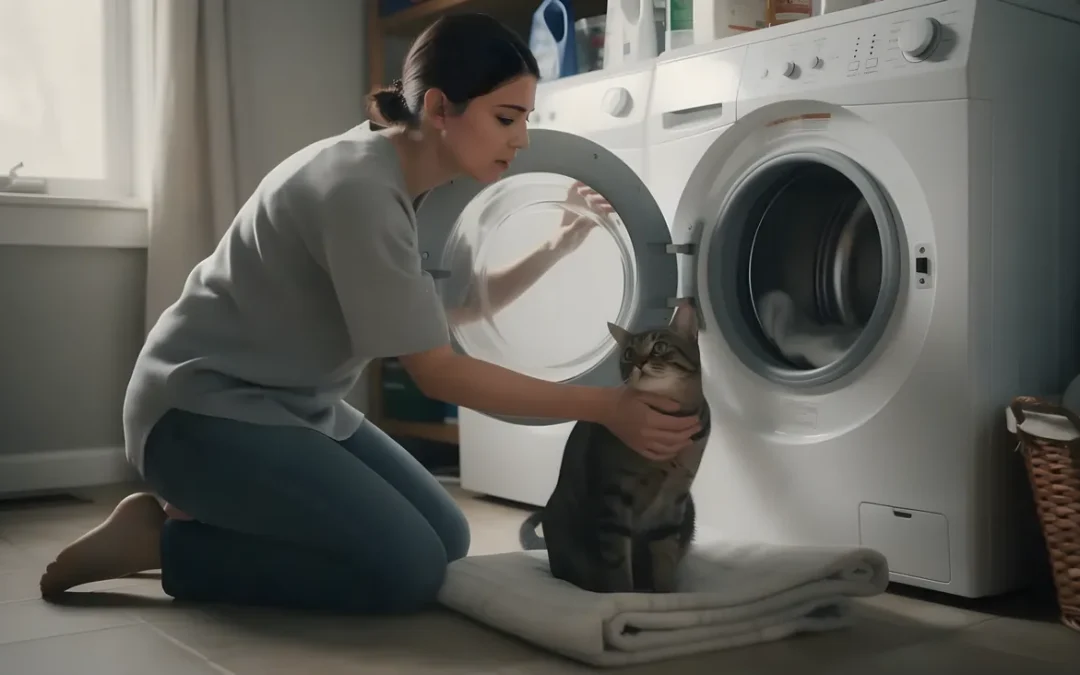
Turn off the dryer and carefully lift your cat out. Do not manipulate limbs, neck, or spine. If something looks bent or wrong, leave her in the position you found her in until you can get her to the vet.
If This Just Happened
- Turn off the dryer right away.
- Lift her out carefully. Don’t twist or bend her limbs, neck, or spine.
- Check for breathing and a pulse. Start pet CPR if you don’t feel either.
- Hot to the touch or panting hard? Cool her down with cool, not cold, water or a damp towel on her ears and paws.
Then keep reading. What happens next depends on how long she was actually inside.
Check for breathing and a pulse. If you don’t feel either, begin pet CPR immediately and get to the vet or an emergency animal hospital as fast as you can.
If she’s hot to the touch or panting hard, that’s hyperthermia, and cooling her down starts before you even finish checking her over. Cool, not cold, water or a damp towel on her ears and paws works fast. A fan pointed her way helps too, if you’ve got one nearby. Cold water can send her into shock, so stick with cool.
Once she’s breathing steady and starting to cool down, check her over for injuries. Cover any burns with clean, non-stick gauze if you have it. If a limb looks broken, skip the splint and get her to the vet fast. Get her into a carrier and go.
How Long Was She in the Dryer?
How long she was actually in there tells you what happens next: longer exposure means more severe complications in documented cases.
Duration At A Glance
Under 1 Minute
Watch her closely for 20 to 30 minutes. Call your vet if anything changes, even something small.
1 to 2 Minutes
Call your vet or an emergency line now for guidance, especially on a heat cycle.
5 Minutes
A vet visit is the safer call, even if she looks and acts completely normal.
10+ Minutes
Go straight to the emergency vet. Don’t wait to see how she seems first.
Under a minute or 30 seconds: Watch her closely for the next 20 to 30 minutes. If she’s breathing normally, walking fine, and acting like herself, she’s likely okay. Call your vet anyway if anything changes, even something small.
1 to 2 minutes: Keep watching just as closely, but call your vet or an emergency line right now for guidance, especially if the dryer was running a heat cycle and not just tumbling with no heat.
5 minutes: This is long enough on a heat cycle that a vet visit is the safer call, even if she’s walking around your kitchen looking completely normal. Looking fine and being fine are not always the same thing after five minutes of heat.
10 minutes or more: Go to the emergency vet. Don’t wait to see if she seems fine first. Pete the Vet documented a British shorthair named Monica who spent 10 minutes on a heat cycle, needed two days of hospital care, and made a full recovery: fast action made the difference.
You may have seen the recent story out of Melbourne about a cat who survived about 4 hours in a dryer. That’s a rare outlier who needed days of intensive care to pull through, not proof that a dryer is ever safe for any length of time.
Any symptom at all, at any duration, means call the vet. No exceptions, no waiting it out.
Signs That Mean This Was Serious
Some signs show up right away. Others take time.
Watch For These Signs
- Burns or singed fur
- Wounds or scrapes
- A broken bone
- A temperature of 104°F or higher
- Gums that are bright red, blue, or pale
- A fast pulse or labored breathing
- Signs of shock
- Disorientation or unequal pupils
Some of these take time to show up. Watch her closely for the next 24 to 48 hours, and call your vet the moment anything changes.
Watch for burns or singed fur, wounds or scrapes, a broken bone, or a temperature of 104 degrees or higher, which is the threshold for hyperthermia in cats. Check her gums too: bright red, blue, or pale all mean something’s wrong. A fast pulse or labored breathing, signs of shock, or disorientation and unequal pupils all point to something more serious than a scare.
Even if she looks completely fine right after you pull her out, watch her closely for the next 24 to 48 hours. Some of these signs, especially the ones tied to organ stress, don’t show up right away. A cat who seems normal Tuesday night can be in trouble by Wednesday afternoon. Any new symptom, even one that seems minor, is worth a call to the vet.
How to Keep This From Happening Again
A few pet safety habits go a long way here.
Prevention Habits Worth Building
- Keep the litter box out of the laundry room.
- Close the washer and dryer doors between loads.
- Check inside before every load, even one hour after the last.
- Feel and listen, not just look. A heavy load can muffle a meow.
- More than one cat at home? Do a headcount before you start a load.
Worried this could happen again? Appliance locks that prop the door open slightly can help, without letting a cat squeeze through.
Don’t keep the litter box in the laundry room. It teaches your cat that room is safe territory, right next to the one appliance that isn’t.
Keep the washer and dryer doors closed between loads. Always check inside before you press start, every single time, even if you just did laundry an hour ago.
Don’t just look. Feel around and listen too. A cat curled up in a pile of towels is easy to miss with a glance, and a heavy load can muffle a meow enough that you won’t hear her over the machine.
If you’ve got more than one cat in the house, do a quick headcount before you start a load. It’s easy to assume the one you can see is the only one home.
If this is a recurring worry in your house, look into appliance locks that prop the door open just slightly. They prevent accidental entrapment: too narrow for a cat to squeeze through, wide enough to keep air moving.
Why a Trained Pet Sitter Notices Things Like This
This is exactly the kind of thing a trained, CPR-certified pet sitter catches. When I’m in a client’s home checking on their cat, I’m not just filling a food bowl and leaving. I’m watching for the open dryer door, the cat who didn’t come running like usual, the load of towels that looks a little too still.
Our grandkitties can’t tell us when something’s wrong. Someone paying attention has to notice for them.
If you’re heading out of town and want someone watching for the little things, in-home cat sitting is what we do. Call 214-244-1629 or reach out anytime.
Frequently Asked Questions
How long can a cat be in a dryer? There’s no single safe number. Some cats come out of a brief accidental spin completely fine. But documented cases at 10 minutes and beyond have needed days of hospital care for heat stroke, organ stress, or eye injuries. Any time on a heat cycle is a veterinary emergency: call your vet.
How many cats die in dryers each year? Widely cited estimates put the number somewhere around 100 to 200 cats a year in the U.S. There’s no official government count behind that figure, so treat it as a rough estimate, not a hard statistic. Real accident, though, not a freak occurrence.
Want someone who notices the little things when you’re not home? Call 214-244-1629 or visit our contact page.

Susan Gary owns Top Dog Pet Sitters in McKinney, Melissa, and Celina, TX, with her husband, Erick. She has been a professional pet care provider since 2015. Susan is a member of Pet Sitters International, is a founding member of the Texas Pet Sitters Association, and certified in pet CPR/First Aid. Susan is a long-time McKinney resident and a retired minister. Learn more about her here.