
One of my walkers, Gina, was taking a golden named Cooper through the trails at Craig Ranch Park last spring. Nice afternoon. Cooper was well-behaved, heel-trained, about 65 pounds.
The dog 15 feet ahead of them on a retractable leash was the problem, a young lab mix named — well, we never got the name. What we got was the full scenario: the lab spotted a squirrel, hit the end of the cord at a dead sprint, and the plastic handle flew out of the owner’s hand. The handle cracked against the pavement. The lab panicked. A 50-pound dog bolted through the park with a rattling plastic block chasing it on a cord, getting louder with every stride.
It took three people and seven minutes to catch that dog. No one was hurt that day. That’s not always how it goes.
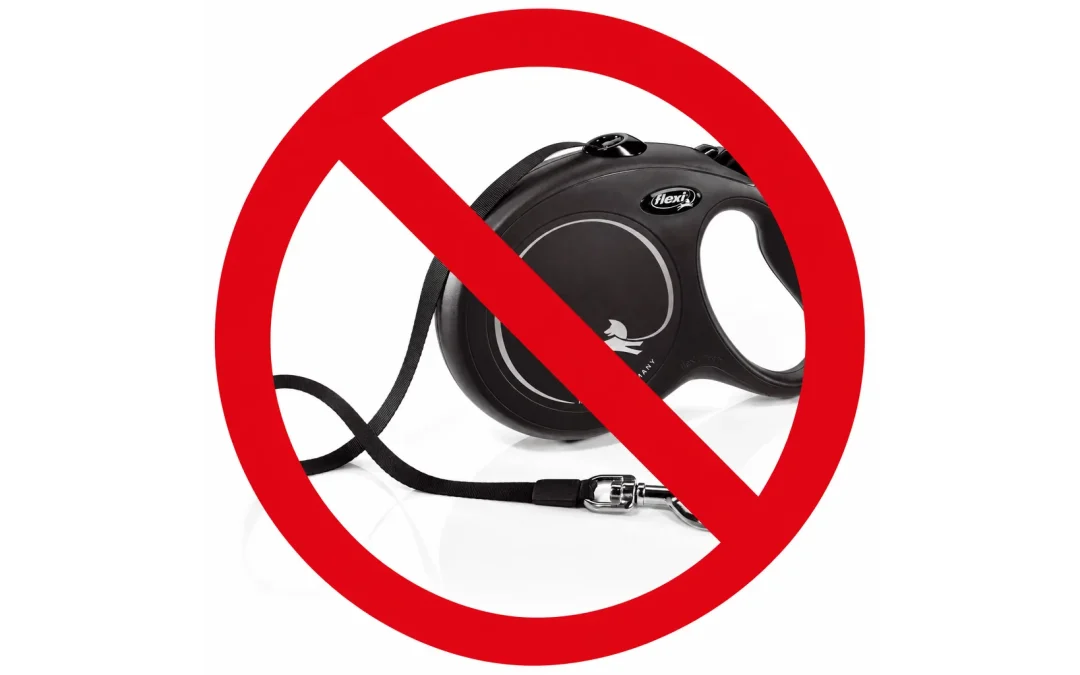
I’ve been walking dogs professionally in McKinney since 2015. I’m a member of Pet Sitters International (PSI), certified in pet CPR and First Aid, and I run a team of 10 professional pet sitters and dog walkers serving McKinney, Melissa, and Celina. Our team has one rule about retractable leashes: no. Not for any dog. Not once. That rule has been in place since we started.
Here’s why.
Retractable Leash Dangers for Your Dog
Retractable leashes are dangerous for dogs primarily because the design removes handler control at the exact moment an emergency occurs. Pet parents want to give their dogs freedom to sniff, wander, and move at their own pace. That instinct is good. The tool is the problem.
What happens when the cord snaps
Cord recoil speed
Snapped retractable cords have been documented returning toward the handler at over 35 mph. At that speed, the cord cuts skin rather than bouncing off it.
Neck injury risk
A 2024 JAVMA review identified leash-related neck injuries as “an understudied public health risk.” Tracheal bruising, tracheal laceration, and cervical spine damage are all documented outcomes from cord tension alone.
At Top Dog Pet Sitters, no retractable leashes are used on any walk. Every dog, every time.
Retractable leashes allow pups to be too far from their humans, and that distance closes faster than anyone expects. A pup can run into the street or make uninvited contact with other dogs or people before the owner’s thumb can even find the lock button. It is much easier to regain control of a dog at the end of a six-foot standard flat leash than if he’s 20 or so feet away at the end of what amounts to a thin cord.
At 20 feet, you have no control. You have the illusion of control.
A powerful dog can break the thin cord of a retractable leash. When that cord snaps under tension, it does not go slack. It recoils. Engineering tests have documented snapped cords returning toward the handler at speeds exceeding 35 mph. A thin cord moving at that speed will cut skin, not just sting it.
Then there are the retractable leash injuries that happen when the leash does not break at all.
Dogs have received serious injuries when the cord runs out at full speed. The sudden jerk on the neck can result in neck wounds, lacerated tracheas, and cervical spine injuries. This is not anecdotal. A 2024 review in the Journal of the American Veterinary Medical Association (JAVMA, Vol. 262, Issue 7) called leash-related neck injuries an understudied public health risk. The trachea and cervical vertebrae absorb the full stopping force, and the damage can range from tracheal bruising to tracheal laceration to spinal injury. For brachycephalic breeds (pugs, French bulldogs, English bulldogs, and other dogs with compressed airways), the risk of tracheal collapse from a single hard jerk is real and documented.
Veterinarians and professional organizations broadly advise against retractable leashes, particularly for dogs prone to pulling. The physics do not care about the breed.
And then there’s the dropped handle.
Retractable leash handles are bulky and often dropped. That might sound like a minor inconvenience. It is not.
Here is what actually happens: the handle hits the pavement with a bang. The dog startles. The dog bolts. The handle, still attached by cord, follows the dog. It clatters. Louder. The dog runs faster because something is chasing it. Now you have a panicked dog running at full speed through a McKinney neighborhood or park with a hard plastic block bouncing behind it, getting louder every second. The dog has no way to stop it. You have no way to stop it. That is not a minor inconvenience. That is how dogs get hit by cars.
Some municipalities have reached the same conclusion. Saanich, B.C. voted 8 to 1 in November 2023 to ban retractable leashes outright. Many veterinary clinics and off-leash dog parks now post signs prohibiting them at the entrance.
Retractable Leash Injuries to Handlers and Dog Walkers
The dangers of retractable leashes do not stop with the dog.
Dog-walking ER visits in the U.S. (2001 to 2020)
7,200
ER visits in 2001
32,000+
ER visits in 2020
423,000
total adults treated over 20 years
Source: Harvard Health analysis of NEISS data. Retractable leashes are a documented contributor to handler cord injuries, falls, and lacerations in this dataset.
Pet parents and dog walkers can easily get tangled in a retractable leash cord, causing serious injury from falling. The cord is thin and nearly invisible at ground level, which makes it a tripping hazard not just for the person holding the handle but for anyone nearby: cyclists, kids, other walkers, elderly pedestrians who have no idea there is a leash strung across the path 12 inches from the ground.
If a person grabs the cord to reel in the pup, the result can be cord burns, lacerations, and in documented cases amputation. That is not an exaggeration. A cord under tension running across skin at speed acts like a saw. The Consumer Product Safety Commission (CPSC) recalled approximately 223,000 SlyDog retractable leashes in 2008 after clasp failures caused facial injuries. Cord injuries to hands and fingers have been documented in emergency room data as far back as 2007, when a CPSC report found that 23.5% of leash-related hospital injuries involved the fingers.
Pet parents and dog walkers have been pulled off their feet by a dog that reaches the end of the cord, resulting in road rash, broken bones, or worse. Adults 65 and older are statistically far more likely to fall, break a bone, or sustain a head injury when a dog pulls them. We walk dogs for clients across every age range. This is not a theoretical risk.
The numbers are striking. Approximately 423,000 U.S. adults were treated in emergency rooms for dog-walking injuries between 2001 and 2020, according to a Harvard Health analysis of National Electronic Injury Surveillance System (NEISS) data. Annual ER visits from dog-walking injuries went from roughly 7,200 in 2001 to more than 32,000 in 2020. That is quadrupled in two decades. Retractable leashes are not the only cause, but they are a well-documented contributor to retractable leash injuries in that data.
Why Retractable Leashes Are Bad for Training
Here is something I hear a lot from pet parents: “My dog pulls on the leash and I don’t know why.”
Why your dog keeps pulling (and what to do about it)
Retractable leashes teach dogs that pulling forward gets results. That is variable reward scheduling, the same mechanism that makes slot machines compelling. The behavior does not stop because it has worked before and might work again.
The fix is simple:
- Switch to a fixed four-to-six-foot flat leash (the AKC’s explicit recommendation)
- Keep the boundary consistent: leash goes taut at six feet, every single time
- Stop walking the moment the leash tightens; resume when your dog returns to your side
- Expect two to four weeks of retraining before the new rule sticks
Our walkers reinforce loose-leash habits on every walk. If your dog has a pulling history, let us know when you book and we will note it in the file.
There is often a retractable leash in that family’s history.
This is the part most retractable leash articles skip. When a dog pulls forward on a retractable leash, the cord sometimes extends. When it does, the dog learns that pulling works. That is a trained behavior, and it is reinforced every single time the cord extends in response to forward pressure.
Trainers call this variable reward scheduling. It is the same mechanism that makes slot machines compelling: the reward does not come every time, so the behavior does not extinguish. Your dog does not stop pulling because pulling has worked before and might work again. On a retractable leash, it frequently does.
Loose-leash walking is one of the most valuable skills you can teach a dog, and it is nearly impossible to train on a retractable leash. The rule changes every step. On a six-foot flat leash, there is a consistent boundary: the leash goes taut when the dog is six feet ahead. On a retractable, the boundary moves. Sometimes it is three feet. Sometimes it is 18. The dog has no idea what the rule is because the rule does not exist.
The American Kennel Club (AKC) explicitly advises against retractable leashes for training and recommends a fixed four-to-six-foot leash for all leash work. That is a flat recommendation, not a nuanced suggestion with exceptions.
My team sees this firsthand in McKinney, Melissa, and Celina. Dogs that have spent years on retractable leashes come to us with a pulling habit that is deeply ingrained. It takes real work to undo. The good news is that it can be undone, and a consistent flat leash is the starting point.
Retractable Leash Alternatives That Professional Dog Walkers Actually Use
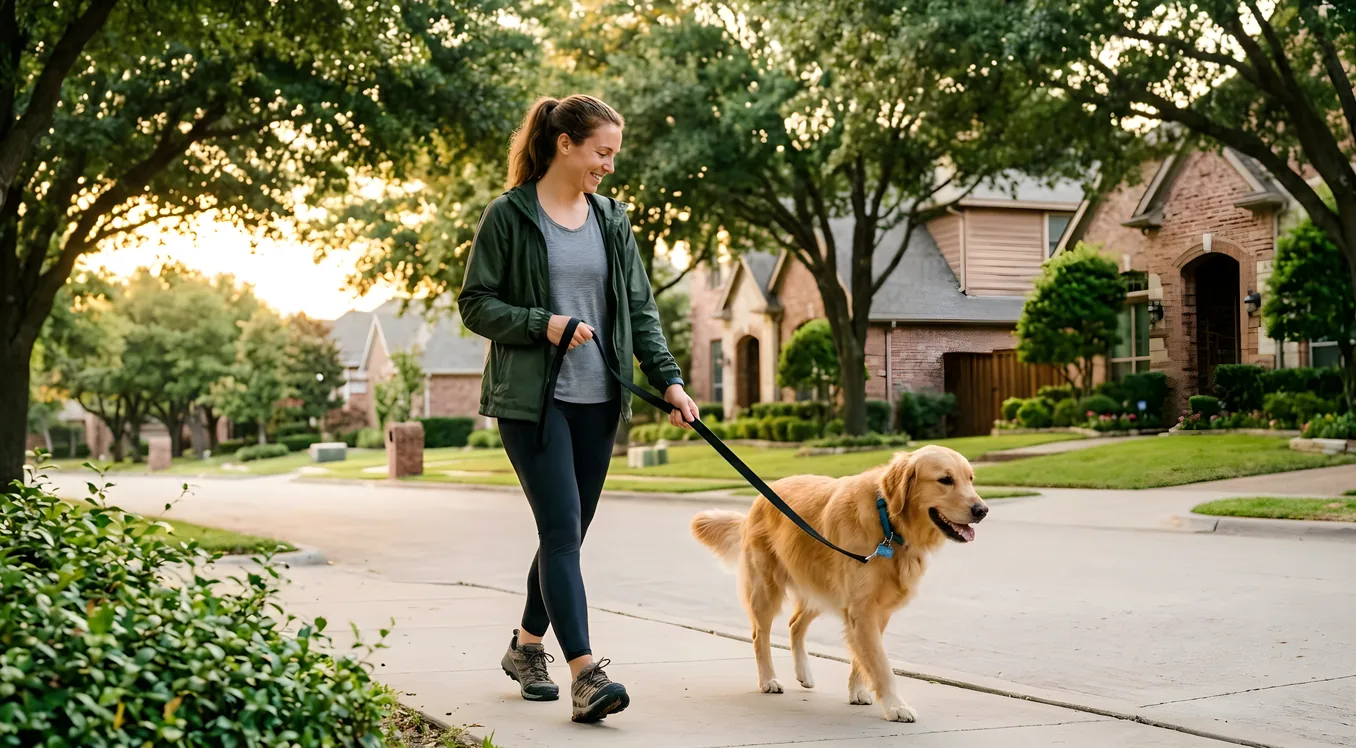
We use six-foot flat leashes. Every walker on my team. Every dog. Every time.
Flat leash materials at a glance
Biothane
Waterproof and odor-resistant. Stays grippy when wet. A good choice for Texas summers where humidity and rain are part of every season.
Leather
Develops grip and feel with use. Comfortable in the hand over long walks. Higher upfront cost, but a quality leather leash lasts for years.
Nylon
Widely available and affordable. Works well for most dogs. Look for a padded handle if your dog is a strong puller.
For open-field sniff time: a fixed long line (15 to 20 feet of flat nylon or biothane, no spring mechanism) gives your dog real freedom without the runaway-handle risk. Not a sidewalk tool, but the right call for a park or open field.
Six feet is the right distance because it keeps the dog in your immediate control range. At six feet, you can gather the leash quickly if another dog approaches, if a car pulls out, if a kid on a scooter appears from nowhere. You can stop, redirect, and protect. At 20 feet, you are an observer, not a handler.
For materials, my personal preference is biothane. It is a synthetic material that is waterproof, does not hold odor (which matters more than you’d think after a few months of regular walks in Texas heat), and stays grippy even when wet. Leather is also excellent and develops a better feel with use. Nylon works fine. What all three have in common: no spring mechanism, no brake button, no retracting cord.
For pet parents who genuinely want to give their pup more room to sniff and roam, a long line is the right retractable leash alternative. A long line is a fixed, non-retracting cord, typically 15 to 20 feet of flat nylon or biothane, without a spring mechanism. Used in an open field or a park with no foot traffic, it gives a dog real freedom without the runaway-handle risk. It is not a suburban sidewalk tool, but for a big open space where you want your dog to range and sniff, it does what retractable leashes promise without the dangerous mechanics.
Why professional dog walkers in McKinney, Melissa, and Celina walk one dog per leash, on a six-foot flat lead, comes down to one word: control. When something happens, and something always eventually happens, a professional has to be able to respond in the first two seconds. A retractable leash does not allow for that. A flat six-foot lead does.
We have been doing this since 2015. The no-retractable rule is not arbitrary. It comes from watching what goes wrong, consistently, with the same piece of equipment.
Keep your pup, yourself, and your dog walker safe.
Looking for dog walking in McKinney, Melissa, or Celina? Call 214-244-1629 or visit our contact page.
Frequently Asked Questions
Why do vets not recommend retractable leashes?
Most vets have seen the injuries firsthand. A dog sprinting to the end of a retractable cord takes the full stopping force through the neck. That can mean anything from a bruised windpipe to a torn trachea to vertebral damage. Short-nosed breeds like pugs and French bulldogs are at even higher risk because their airways are already narrow. One bad jerk can trigger tracheal collapse. JAVMA flagged these injuries as an understudied problem in a 2024 review.
Are retractable leashes bad for training?
Yes. Every time the cord extends after a pull, the dog gets rewarded for pulling. Behaviorists call that variable reinforcement, and it is one of the hardest patterns to break. The AKC specifically says to use a fixed four-to-six-foot leash for training. No exceptions.
What are the best retractable leash alternatives?
A standard six-foot flat leash. That is it. Biothane if you want waterproof and odor-resistant. Leather if you like how it breaks in over time. Nylon if you want something cheap that works. All three give you direct control without any spring-loaded mechanics. For off-leash areas where you still want a tether, a 15 to 20 foot long line made of flat webbing gives your dog room without the retractable’s failure modes.
What injuries can a retractable leash cause?
For dogs: tracheal lacerations, cervical spine injuries, collapsed trachea (especially in brachycephalic breeds such as pugs, French bulldogs, and English bulldogs), and neck wounds from the sudden stop when the cord runs out. For people: cord burns, lacerations, and in documented cases amputation from grabbing a cord under tension. Falls, road rash, and broken bones from being pulled off your feet. The CPSC documented clasp failures in the SlyDog recall (2008) that caused facial injuries. The dropped handle also creates a secondary hazard: a panicked dog bolting with a rattling plastic block following on a cord.
Why are retractable leashes banned in some places?
Several municipalities and many veterinary clinics have restricted or banned retractable leashes because the risk profile is documented and consistent: cord breaks, dropped handles, fall injuries to handlers, and neck injuries to dogs. Saanich, B.C. voted 8 to 1 in November 2023 to ban them. The argument is the same one we apply at Top Dog Pet Sitters: the tool’s design creates hazards that a standard flat leash simply does not.
Are retractable leashes bad for all dogs?
Yes. The cord-snap risk, the dropped-handle scenario, and the training interference apply regardless of breed or size. The JAVMA review did not carve out exceptions by breed. Brachycephalic dogs face additional tracheal risk, but the mechanical dangers from cord tension and handle drop affect every dog on a retractable leash.
Looking for professional dog walking in McKinney, Melissa, or Celina? Call 214-244-1629 or visit our contact page.

Susan Gary owns Top Dog Pet Sitters in McKinney, Melissa, and Celina, TX, with her husband, Erick. She has been a professional pet care provider since 2015. Susan is a member of Pet Sitters International, is a founding member of the Texas Pet Sitters Association, and certified in pet CPR/First Aid. Susan is a long-time McKinney resident and a retired minister. Learn more about her here.