
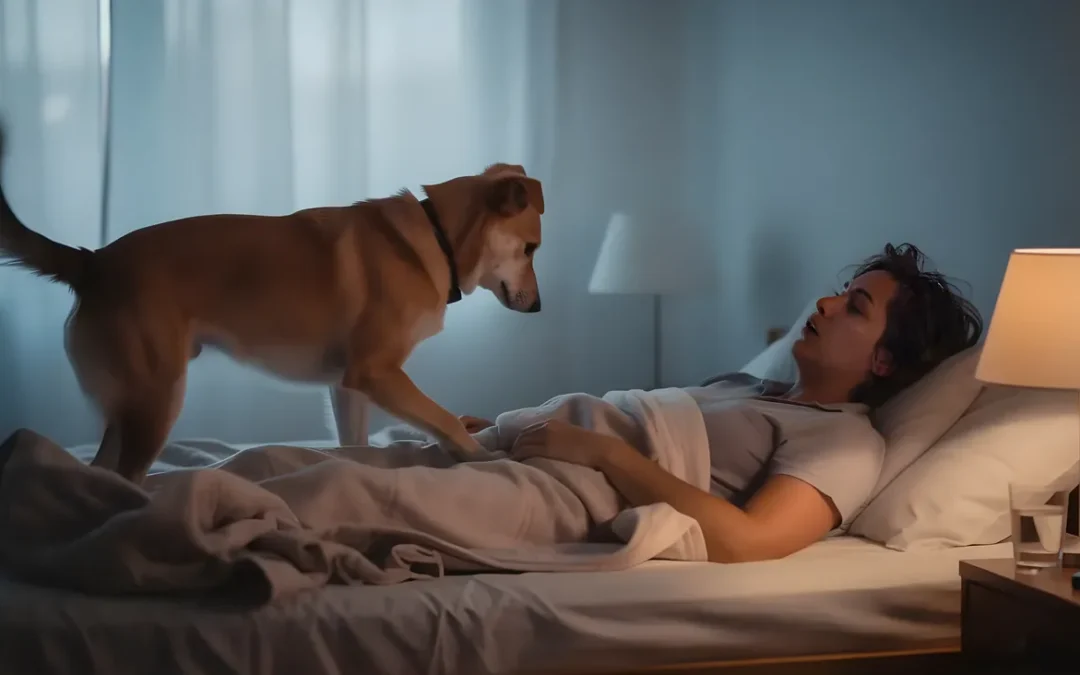
WHEW! It’s been a long, stressful week and you are looking forward to sleeping in. Unfortunately, your dog has other ideas.
If your pup wakes you up too early, it usually means they are uncomfortable about something. In ten-plus years of caring for dogs in McKinney and Melissa, I’ve gotten this question a lot. Pet parents are tired, frustrated, and not sure whether the early waking is behavioral, medical, or just something they have to live with. The answer is usually one of a handful of causes, and most of them are fixable once you know what you’re actually dealing with.
Let me walk you through what I’ve learned.
Dogs Are Not Built to Sleep Like We Do
Before we get into the why, it helps to know that dogs are fundamentally different sleepers.
Dog Sleep vs. Human Sleep at a Glance
Dogs
20-30 sleep episodes per day
~20-minute sleep cycle
Circadian rhythm tied to light and household routine
Humans
One consolidated overnight block
~90-minute sleep cycle
Circadian rhythm tied to light, but less flexible to routine shifts
A dog who is genuinely done sleeping at 5am is not misbehaving. They have completed their sleep cycles. That is the starting point for solving the problem.
Humans consolidate most of their sleep into one long overnight block. Dogs don’t. A healthy dog may have 20 to 30 sleep episodes spread across a full 24-hour day, each one lasting anywhere from a few minutes to a couple of hours. Their internal sleep cycle runs about 20 minutes from start to finish, compared to the human sleep cycle, which runs roughly 90 minutes. That difference explains a lot.
By 5am, your dog may have genuinely cycled through all the sleep they need. From a biological standpoint, they’re done. They’re not being difficult. They’re not trying to annoy you. They’re just awake, alert, and looking at you wondering what happens next.
A dog’s circadian rhythm, the internal biological clock that governs when to be awake and when to sleep, ties more closely to your household routine and to ambient light levels than to the time on the clock. If you consistently wake up at 6:15am, your dog’s circadian rhythm learns to anticipate that. Start adjusting your wake time and their body will adjust too, but it takes time.
The Most Common Reasons Your Dog Is Up Before You
They Need to Go Outside
Five Adjustments Worth Trying First
Before overhauling anything, run through this list. Most early waking resolves with one or two targeted changes.
Last potty break right before bed
Reduces bladder-pressure wake-ups. Most reliable single adjustment.
Room darkening curtains
Light is the strongest circadian trigger for dogs. In North Texas in late June, the sky lightens well before 6am.
Afternoon exercise, not late-night
Intense exercise within two hours of bedtime can leave dogs overstimulated, not tired.
No response until your actual wake time
Eye contact, grumbling, and getting up all reward the behavior. Consistency for 2-3 weeks is the minimum.
Move the second meal to evening
If you feed once in the morning, your dog’s body anticipates that feeding before your alarm goes off.
This is the first thing to rule out, and it’s also the easiest to address. One last potty break right before bed is the single most reliable adjustment for dogs waking early due to bladder pressure. For most dogs on a stable schedule, that extra trip makes a real difference.
Two things worth knowing here:
Puppies under 6 months have smaller bladders and shorter holding times. An 8-week-old puppy waking at 4am to go outside is doing the right thing. That is not a problem to fix; it’s a developmental reality that resolves as they grow.
Adult dogs who have always been solid through the night and suddenly can’t make it to morning are telling you something. A urinary tract infection (UTI) is one of the most common culprits. UTIs cause urgency and bladder discomfort, and a dog with a UTI may simply not be able to hold it any longer than they do. This is worth ruling out before you assume the behavior is something to train away. UTIs are more common in female dogs and senior dogs, and they are easily treated once diagnosed.
Senior dogs also need more frequent bathroom trips as they age. If your dog is over 7 and has started waking earlier, mention it to your vet.
Light Is Waking Them Up
This one I know firsthand.
Our pups sleep much later when we close the door to our bathroom. Our bathroom faces east and so the morning light is bright. We also invested in room darkening curtains that made a world of difference.
Dogs respond to increasing light as a wake-up signal. Light exposure is one of the strongest environmental cues the canine circadian rhythm uses to decide when to start the day. In North Texas, sunrise in late June is around 6:09am, but the sky starts lightening well before that. If your bedroom or your dog’s sleeping space faces east and doesn’t have good window coverings, you’ve basically set a biological alarm clock that you can’t turn off by pulling the covers over your head.
Room darkening curtains are one of the highest-return fixes for this problem. If you’re not ready for that, even closing the door to a room that gets morning sun can help. White noise can also take the edge off early-morning sounds from the neighborhood: garbage trucks on Tuesday mornings, sprinklers, birds, all of it.
They Still Have Energy to Burn
Excess energy is another big one. If your pup is not getting the physical activity they need during the day, that energy has to go somewhere. And 5am is apparently somewhere.
Dogs who receive adequate daily exercise reach genuine fatigue before bedtime, which reduces early-morning restlessness. A pre-bedtime walk can help, but timing matters.
Intense exercise within two hours of bedtime can actually leave some dogs overstimulated rather than tired. The better window is the afternoon or early evening. You want the energy burned, not the excitement fresh.
Mental stimulation matters just as much as physical exercise. A dog who is physically tired but mentally under-stimulated will still look for an outlet. Puzzle toys before bed are great for this because they burn cognitive energy in a calm, focused way. A pre-loaded Kong or snuffle mat drains mental energy without spiking arousal.
If you have a Border Collie, an Australian Shepherd, a Jack Russell Terrier, or any other working or herding breed, know that these dogs were selectively bred to stay alert and active across long working days. They need more than a standard walk to reach genuine fatigue. That’s not a complaint about those breeds; it’s just the reality of their wiring.
You’ve Accidentally Trained It (Without Knowing It)
This section might sting a little, but it’s worth understanding because it’s one of the most common reasons early waking becomes a fixed habit.
When your dog wakes you at 5am and you respond in any way, you have rewarded the behavior. That includes grumbling at them. That includes stumbling to the kitchen. That includes making eye contact. In your dog’s mind, waking you at 5am produced a result. So they do it again.
Dogs don’t hold grudges and they don’t plan ahead. They repeat what works. If waking you at 5am consistently gets them fed, let outside, or given even a moment of attention, the behavior becomes trained.
The fix: no eye contact, no verbal response, no getting up until your actual wake time. The key word is CONSISTENTLY. If you ignore it four days and then respond on the fifth because you’re exhausted, you’ve actually made the behavior more persistent, not less. Inconsistent reinforcement is harder to extinguish than consistent reinforcement. Behavioral science calls this intermittent reinforcement, and it’s the reason slot machines are hard to walk away from.
Give it two to three weeks of true consistency before evaluating whether it’s working.
Hunger or an Off Feeding Schedule
A growling tummy can wake your pup up. If you feed your dog first thing in the morning, their body has learned to anticipate that feeding. Anticipatory arousal, the physical restlessness that builds before a known reward, can start before your alarm. That means your dog is awake and motivated to get you moving before you planned to be.
Feeding dinner a little later or adding a small bedtime snack can help. If you’re on a once-daily morning feeding schedule, that’s an especially likely contributor to pre-dawn waking. Switching to two smaller meals, with the second one in the evening, gives your dog’s digestive system a later anchor point.
Anxiety or Boredom
Some dogs wake early specifically because they’re already anticipating the transition. You’re about to get up, get ready, and leave. For a dog with separation anxiety, the morning hours can carry a particular kind of dread. Their cortisol levels begin rising before the routine even starts.
Puzzle toys left out overnight or a Kong stuffed the night before can give an anxious early-riser something to focus on. Calm, low-stimulation activities help more than play, which tends to spike energy at the wrong time.
If what you’re seeing looks more like genuine distress (pacing, whining, shaking), that’s worth a conversation with your vet or a certified professional dog trainer. Separation anxiety responds well to structured behavioral intervention, but it takes time and a plan.
When Early Waking Is a Health Problem
Sometimes the early waking is not about behavior at all. It’s a symptom.
Call Your Vet If You Notice Any of These
Behavioral changes can’t fix a medical problem. These signs point toward a vet visit rather than a training plan.
Possible UTI
Frequent trips that produce only small amounts of urine, straining, or visible discomfort. More common in female and senior dogs.
Possible Osteoarthritis
Pacing or pawing at you after lying still all night. Joint inflammation worsens with inactivity. Pain management, not training, is the fix.
Possible Cushing’s Disease
Restlessness, panting, increased thirst and urination, and a pot-belly appearance alongside sleep disruption.
Possible CCDS (dogs 7+)
Sleeping more during the day, restless or disoriented at night. Canine Cognitive Dysfunction affects an estimated 14-35% of dogs over age 8 and is commonly missed.
I’ve seen this in client dogs over the years, and it’s worth knowing what to watch for, especially in dogs who had stable sleep schedules before.
Urinary Tract Infection (UTI): A UTI causes urgency and bladder discomfort that overrides a dog’s ability to hold through the night. The main signs are frequent trips outside that produce only small amounts of urine, straining, or visible discomfort while urinating. More common in female dogs and senior dogs. Easily treated with antibiotics once diagnosed by a vet.
Osteoarthritis: Joint inflammation worsens with inactivity. A dog who has been lying still all night may reach a point of real joint pain in those early morning hours and start pacing or pawing at you to move. This is not attention-seeking in the behavioral sense. It is pain-driven movement. Behavioral modification won’t touch it. Prescription pain management from a veterinarian will.
Cushing’s Disease (Hyperadrenocorticism): This is a condition where the adrenal glands produce too much cortisol, the hormone that signals wakefulness and arousal. Dogs with Cushing’s disease often have disrupted sleep-wake cycles, along with panting, restlessness, increased thirst and urination, and a pot-belly appearance from muscle wasting. More common in middle-aged to older dogs. If you’re seeing a combination of those signs alongside early waking, it’s worth raising with your vet.
Canine Cognitive Dysfunction Syndrome (CCDS): This is the one I really want to flag for anyone with a senior dog.
Canine Cognitive Dysfunction Syndrome is the canine equivalent of Alzheimer’s disease in humans. It affects an estimated 14 to 35 percent of dogs over age 8 and is significantly underdiagnosed. One of the earliest and most consistent signs is a shift in the sleep-wake pattern: dogs with CCDS often sleep more during the day and become restless, vocal, or disoriented at night or in the early morning hours. This is called sleep-wake cycle reversal.
If your dog is over 7 and has started waking earlier or becoming restless at night, and you can’t trace it to a behavioral or environmental cause, please bring it up at your next vet visit. Early recognition matters. Your veterinarian can assess for CCDS using standardized behavioral questionnaires and discuss management options.
When to Call Your Vet
Most early waking is behavioral or environmental and responds to the fixes listed above. But these red flags warrant a phone call sooner rather than later:
- Sudden onset of early waking in a dog with a previously stable sleep schedule
- Night waking with panting, pacing, or visible distress
- Waking to urinate multiple times, or urgency and straining while urinating
- Any dog over 7 showing new sleep disruption
- Early waking paired with confusion, disorientation, or unusual nighttime behavior
- Physical changes alongside the sleep shift: increased thirst, weight changes, pot belly, hair thinning
If anything on this list sounds familiar, start there before trying to adjust the behavior.
A Note on Age: Puppies, Adults, and Senior Dogs Are Different
The right response to early waking depends a lot on where your dog is in life.
What to Do Based on Your Dog’s Life Stage
Puppies (under 6 months)
Early waking is normal. Their sleep cycle is still establishing.
Focus on: Consistent schedule, last potty break before bed, patience. Most puppies settle into a reliable overnight pattern by 6 months.
Adult Dogs (1-7 years)
Early waking in an otherwise stable adult is usually behavioral or environmental.
Focus on: Light exposure, feeding timing, exercise windows, and the accidental reinforcement loop. Give it 2-3 weeks before calling the vet.
Senior Dogs (7+)
Sleep becomes lighter and more fragmented with age. New disruption in this group is more likely to have a medical cause.
Focus on: Mention any new sleep changes at your next vet visit. CCDS and osteoarthritis are the two most common culprits here.
Puppies (under 6 months): Their circadian rhythm isn’t established yet. Early waking is part of being a puppy, not a behavioral problem to solve. The goal is a consistent schedule, a last potty break right before bed, and patience. By around 6 months, most puppies begin settling into a more predictable overnight pattern.
Adult dogs (1 to 7 years): Early waking in an adult with a previously stable schedule is most often behavioral or environmental. Light exposure, schedule drift, feeding timing, and the accidental reinforcement loop are the first things to look at. If you’ve worked through all of those consistently for two to three weeks and nothing has changed, that’s when a vet conversation makes sense.
Senior dogs (7 and up): Older dogs tend to sleep more overall, but their sleep is lighter and more fragmented. They wake more easily and can struggle to fall back asleep. Canine Cognitive Dysfunction Syndrome and osteoarthritis are the two most common medical causes in this age group. Any new sleep disruption in a dog over 7 is worth mentioning to your vet before assuming it’s behavioral.
FAQ
How do I get my dog to stop waking me up so early?
Start by ruling out medical reasons, especially in dogs over 7. For behavioral waking, the most important rule is consistency: don’t respond to early waking with any attention. Eye contact, grumbling, or getting up all count as rewards and reinforce the behavior. Add a last potty break right before bed, room darkening curtains if your sleeping space gets morning light, and adequate physical and mental exercise during the day. If nothing improves after two to three weeks of consistent non-response, call your vet.
How do I stop my dog from waking up at 5am?
A 5am waker is often responding to light. Dogs use ambient brightness as their primary circadian cue, and here in North Texas the sky begins brightening well ahead of the 6am sunrise window during summer months. If your bedroom or your dog’s sleeping area faces east without good curtains, light is triggering the wake-up before your alarm. Room darkening curtains reduce that early-morning brightness and push the biological wake signal later. If the 5am waking started in spring and gets earlier each week, light is almost certainly your answer.
What is the 7 7 7 rule for dogs?
The 7 7 7 rule is a puppy socialization guideline: expose a puppy to 7 new people, 7 new places, and 7 new experiences by the time they are 7 weeks old. The goal is building behavioral confidence early so the dog is less reactive to new situations as an adult. It is not directly related to sleep schedules, but well-socialized puppies tend to sleep through sounds and environmental changes more easily, which can mean fewer early morning wake-ups as they grow.
How a Mid-Day Visit Can Help
If your dog’s early waking comes down to excess energy, one of the most reliable fixes is making sure they get enough physical and mental activity before evening.
A dog walking in McKinney visit in the middle of the day drains energy at the right time. It gives your dog the outlet they need without the overstimulation that comes from exercising too close to bedtime. For dogs home alone during work hours, it also breaks up the boredom that can build into anxious, restless energy by nighttime.
Pet sitting in McKinney is another option when your schedule gets unpredictable. A familiar, trusted sitter keeps the routine intact even when your day doesn’t cooperate.
Looking for dog walking or pet sitting in McKinney, Melissa, or Celina? Call 214-244-1629 or contact Top Dog Pet Sitters.
Susan Gary owns Top Dog Pet Sitters in McKinney and Melissa, TX, with her husband, Erick. She has been a professional pet care provider since 2015. Susan is a member of Pet Sitters International, is a founding member of the Texas Pet Sitters Association, and is certified in pet CPR and First Aid. She is a long-time McKinney resident and a retired minister. Learn more about Susan here.
Looking for dog walking or pet sitting in McKinney, Melissa, or Celina? Call 214-244-1629 or visit the contact page.

Susan Gary owns Top Dog Pet Sitters in McKinney, Melissa, and Celina, TX, with her husband, Erick. She has been a professional pet care provider since 2015. Susan is a member of Pet Sitters International, is a founding member of the Texas Pet Sitters Association, and certified in pet CPR/First Aid. Susan is a long-time McKinney resident and a retired minister. Learn more about her here.